Pay-per-click advertising (PPC) and search engine optimization (SEO) can both help your business reach potential customers through search engines, but they work in very different ways.
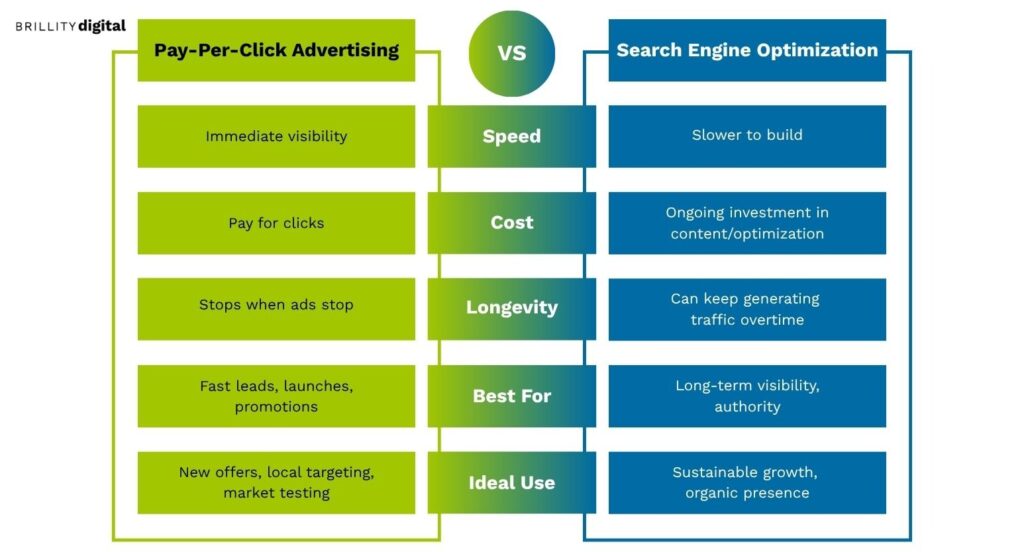
PPC advertising allows you to pay for immediate visibility through platforms such as Google Ads. SEO focuses on earning organic visibility by improving your website’s content, authority, technical performance, and user experience.
SEO can create valuable long-term growth, but it usually takes time to build momentum. PPC can begin generating traffic much faster, but that visibility typically stops when the advertising budget is paused.
For most businesses, the question should not be whether to choose SEO or PPC forever. It should be how to allocate your budget based on your current goals, timeline, and market.
There are several situations where it may make sense to invest more heavily in PPC while continuing to build your SEO foundation.
Key Takeaways
- PPC is often the stronger short-term investment when speed, targeting, or immediate data matters.
- Product launches and limited-time promotions may not have enough time to rely on organic rankings alone.
- PPC can help businesses compete for valuable search terms while their SEO authority develops.
- Geographic targeting makes paid search especially useful for local businesses and defined service areas.
- PPC can test new offers, locations, and audiences before a business makes a larger long-term investment.
- PPC and SEO are most effective when they support one another rather than operate as completely separate strategies.
SEO vs. PPC: What Is the Difference?
SEO helps your website earn visibility in organic search (non-paid) results. A successful SEO strategy may include keyword research, content development, technical improvements, local SEO, internal linking, and website optimization.
PPC allows your business to pay for placement in sponsored search results. Advertisers can control their budgets, target specific searches or audiences, and track actions such as calls, form submissions, bookings, and purchases.
Neither strategy is automatically better.
SEO is valuable for building lasting visibility and authority. PPC is valuable when your business needs to reach a specific audience quickly, gather data, or promote something that cannot wait for organic rankings to develop.
The following five situations are common examples of when investing more in PPC than SEO may make sense.
1. You Are Launching a New Product or Service
A new product or service needs visibility before it can gain traction.
SEO can support the launch by creating optimized service pages, blog content, and other resources, but those assets may take time to rank. If the offer is new, your website may not yet have the authority or search history needed to appear prominently in organic results.
PPC can put the offer in front of potential customers much sooner.
A paid campaign can help you:
- Generate immediate awareness
- Reach people searching for related solutions
- Drive traffic to a dedicated landing page
- Test different messages and offers
- Measure early demand
- Collect data before making a larger investment
This information can also strengthen future SEO efforts. Search terms, ad messages, and landing page content that perform well in PPC can reveal what matters most to your audience.
However, a product launch campaign still needs the right foundation. Driving paid traffic to a confusing or unconvincing page will not produce strong results simply because the ad is visible. Launching something new? Brillity Digital can help you build the campaign, landing page, messaging, and conversion tracking needed to turn initial interest into measurable results.
2. You Are Promoting a Time-Sensitive Offer or Event
SEO is a long-term strategy. A promotion that ends next week cannot wait several months for a page to gain organic visibility.
PPC is often the better investment for:
- Seasonal promotions
- Limited-time offers
- Upcoming events
- Holiday campaigns
- Registration deadlines
- Short-term sales
- Product releases
- Temporary service availability
Paid advertising allows you to launch quickly and control when the ads appear. Campaigns can be scheduled around specific dates, days, or hours, allowing the budget to focus on the period when the offer is most relevant.
You can also target specific geographic areas, audiences, and search behaviors. That control makes PPC especially useful when an event or promotion is only available to a defined group of people.
SEO can still play a supporting role. An optimized landing page or event page can provide useful information and may attract organic traffic. However, PPC should often receive the larger share of the immediate campaign budget when timing is critical.
3. You Need Visibility for Highly Competitive Keywords
The truth is, some search terms are extremely difficult to rank for organically.
Established competitors may have years of content, backlinks, brand authority, reviews, and technical SEO supporting their positions. A newer or smaller business may struggle to reach the first page quickly, even with a strong SEO strategy.
PPC can provide visibility for valuable searches while your organic presence develops.
That does not mean businesses should bid on every popular keyword. Highly competitive terms can be expensive, and broad searches may generate clicks from people who are not likely to become customers.
A strong PPC strategy considers:
- Search intent
- Cost per click
- Expected conversion rate
- Customer value
- Geographic relevance
- Keyword specificity
- Landing page quality
- Available budget
Businesses may also find better opportunities through long-tail keywords. These searches are usually more specific and may indicate that the user is closer to making a decision.
For example, a broad keyword may generate a large audience, while a more detailed service-and-location search may produce fewer clicks but more qualified leads.
PPC data can also inform your SEO priorities. If a keyword consistently generates valuable inquiries, it may deserve a dedicated service page, supporting content, or a larger role in your organic strategy.
Before increasing your budget for competitive keywords, make sure the campaign and landing page are prepared to convert that traffic. A free Brillity PPC Assessment can help identify wasted spend and stronger opportunities.
4. You Need Precise Local Targeting
Local businesses often need to reach customers within a specific city, region, or service area.
PPC platforms provide geographic targeting options that allow businesses to focus their budgets on the locations that matter most. This can be especially helpful for service businesses that do not want to pay for clicks from people outside their coverage area.
Local PPC campaigns can use:
- City or regional targeting
- Radius targeting
- Location-focused keywords
- Location assets
- Call assets
- Ad scheduling
- Device adjustments
- Negative keywords
- Location-specific landing pages
For example, a contractor may want to advertise only within the communities where the team can realistically complete projects. A clinic may focus its campaign on users within driving distance. A multi-location company may use separate campaigns and landing pages for each market.
Local SEO is still essential. An optimized Google Business Profile, location pages, consistent business information, reviews, and locally relevant content can support long-term visibility.
However, PPC can fill immediate gaps, promote priority services, and reach high-intent customers while local organic rankings are still developing.
5. You’re Testing a New Market, Audience, or Offer
Expanding into a new market without reliable data can be expensive.
A business may assume that an offer will perform well in a new city, industry, or demographic, only to discover that the audience responds differently than expected.
PPC provides you with a controlled way to test demand before making a larger commitment.
Businesses can use paid campaigns to test:
- New geographic markets
- Different service areas
- New audience segments
- Alternative offers
- Pricing messages
- Calls to action
- Landing page concepts
- Industry-specific positioning
Campaigns can be launched with defined budgets and measurable goals. If the response is strong, the company can invest more confidently in content, SEO, staffing, and market expansion.
If performance is weak, the business can adjust its messaging, targeting, or offer before committing additional resources.
PPC is especially useful in this situation because it produces direct feedback. Clicks alone are not enough, but conversion data, lead quality, sales conversations, and customer acquisition costs can reveal whether a market is worth pursuing.
When Should SEO Receive More of the Budget?
PPC may deserve more investment in the five situations above, but it should not automatically replace SEO.
SEO may warrant a larger share of the budget when your goals include:
- Building sustainable organic traffic
- Increasing long-term brand authority
- Reducing dependence on paid advertising
- Answering customer questions throughout the buying journey
- Improving visibility for a wide range of related searches
- Strengthening local presence over time
Turning off a PPC campaign can immediately reduce paid traffic. Strong organic content may continue bringing visitors to your website long after it is published.
That is why businesses should avoid viewing PPC and SEO as opposing strategies. PPC can create immediate opportunities and generate valuable data. SEO can turn those insights into long-term assets.
Frequently Asked Questions About PPC and SEO
Is PPC better than SEO?
PPC is not universally better than SEO. It is often more effective when a business needs immediate visibility, precise targeting, or fast performance data. SEO is typically stronger for building sustainable organic growth over time.
Should a new business invest in PPC or SEO first?
Many new businesses benefit from starting both. PPC can generate initial visibility and reveal which messages or searches produce leads. SEO can begin building the content and authority needed for long-term growth.
How much should a business spend on PPC?
The appropriate PPC budget depends on factors such as industry competition, cost per click, conversion rate, customer value, location, and business goals. A realistic budget should provide enough data to evaluate performance without putting the business under unnecessary financial pressure.
Does PPC help SEO rankings?
Running PPC ads does not directly improve organic rankings. However, PPC data can help identify valuable keywords, successful messaging, audience behaviour, and landing page opportunities that strengthen an SEO strategy.
Can PPC and SEO target the same keywords?
Yes. Targeting the same themes through paid and organic search can increase overall visibility and provide useful performance insights. The two channels should be coordinated so they support the broader marketing strategy.
Find the Right Balance Between PPC and SEO
PPC is often the right place to invest more when your business needs speed, precise targeting, immediate data, or visibility for a time-sensitive opportunity.
It can help launch a new offer, promote an upcoming event, compete for difficult search terms, reach local customers, or test a new market before making a larger commitment.
But PPC is most valuable when it is supported by a broader marketing system.
Strong landing pages turn clicks into leads. Accurate tracking reveals which campaigns produce real results. SEO builds long-term visibility. Continuous optimization helps your budget work harder over time.
Brillity Digital combines PPC management, SEO services, landing page optimization, content strategy, analytics, and conversion tracking to help businesses invest in the right channels at the right time.
Wondering whether your budget should prioritize PPC, SEO, or a combination of both? Contact Brillity Digital or book a free PPC Assessment or SEO Assessment to uncover the strongest opportunities for your business.