
A Complete Guide to Setting the Right PPC Budget
Key Takeaways
- There is no universal “right” Google Ads budget. Your spend depends on goals, industry, margins, and competition.
- Small businesses can start effectively with $1,000 to $5,000/month, but meaningful data usually requires consistent testing.
- Your cost per click (CPC) and conversion rate matter more than total spend.
- A successful Google Ads budget is tied directly to return on ad spend (ROAS), not arbitrary numbers.
- Scaling spend should always follow performance data, not guesswork.
- Working with an experienced PPC partner can reduce wasted spend and accelerate results.
- If you are unsure where your budget should fall, it is often more effective to start structured testing rather than waiting for a “perfect number.”
Understanding Google Ads Budgeting
One of the most common misconceptions in pay-per-click advertising is that success is solely determined by how much you spend. In reality, Google Ads performance is driven by how efficiently you’re using your budget.
A $2,000/month campaign with strong targeting and optimization can outperform a $10,000/month campaign with poor structure.
Before setting a budget, you need to understand three core variables:
- Cost-per-click (CPC): The amount you pay each time someone clicks one of your ads.
- Conversion rate: The percentage of people who complete a desired conversion action after clicking on your ads.
- Customer lifetime value (LTV): is the total amount of revenue a business can expect to earn from a single customer over the entire duration of their relationship with that business.
These three factors determine how far your budget will actually go.
It’s critical to do your research, understand industry benchmarks, and come up with a solid strategy before you open your wallet.
What Impacts How Much You Should Spend on Google Ads?
1. Your Industry and Competition
Some industries are significantly more expensive than others.
For example:
- Legal, insurance, and finance often have high CPCs due to fierce competition
- Local services can range widely, depending on the service and geography
- E-commerce varies based on product category and margin
Higher competition typically requires a larger testing budget to achieve statistical reliability.
When looking for an agency to manage your Google Ads, ask for a PPC audit. They should provide one for free. This will give you projected outcomes and help you set a realistic budget and expectations.
2. Conversion Rate
If your website converts poorly, increasing ad spend will only increase inefficient traffic to your site.
For example:
- 1% conversion rate = expensive customer acquisition (CPA) (The amount you pay to acquire an actual paying customer, not just a lead)
- 5% conversion rate = significantly lower cost per acquisition
Improving landing pages often reduces required ad spend more effectively than increasing the budget.
Our experts at Brillity find that landing page optimization reduces required ad spend by 20 to 40% without changing traffic volume.
“We’ve seen clients come to us with cluttered, hard-to-navigate landing pages that receive little to no conversions. After an overhaul by the Brillity team, the landing page was tidy, efficient, and most importantly, made it easy for visitors to complete the desired conversion action!” says Elizabeth Brewing, Director of Performance Marketing.
3. Your Goals (Leads vs Sales vs Awareness)
Different goals require different budget structures:
- Lead generation: Focus on cost per lead (CPL)
- E-commerce: Focus on ROAS
- Brand awareness: Focus on impressions and reach
Geography plays a part as well. A lead generation campaign might start effectively at $1,500 to $3,000/month in local markets, while competitive national campaigns may require significantly higher ad spend.
4. Your Cost-Per-Click (CPC)
CPC determines how much traffic you can realistically buy.
Example:
- $2 CPC with a $2,000 budget = ~1,000 clicks
- $10 CPC with a $2,000 budget = ~200 clicks
If your funnel requires high traffic volume to convert, CPC becomes a massive constraint.
Before starting a Google Ads campaign, ensure you’re doing thorough keyword research. You’ll want to ensure you’re aware of the CPCs in your industry so you can make an informed decision on how much budget you’ll need for success.
If you’re working with an advertising agency, ensure they are asking key questions such as your average sale value, your close rate, and your customer lifetime value. This information is critical in order for an agency to provide you with an informed decision on your ad spend. “If an agency asks for anything less, they’re likely providing you with cookie-cutter estimates that may not apply to your specific industry and geography.” Derrick Kuhn, Managing Director.
5. Your Sales Cycle
Longer sales cycles typically require:
- More nurturing
- Retargeting campaigns
- Higher initial budget to sustain the learning phase
B2B companies often need higher monthly spend than direct-to-consumer funnels because conversions take significantly longer.
Recommended Google Ads Budget Ranges: General Benchmarks
While every business and geographic area is different, here are general starting points:
| Phase | Monthly Budget | Best For | Focus |
| Starter Phase | $1,000–$3,000/month | Local service businesses Early testing Small geographic targeting | Keyword testing Basic conversion tracking Audience validation |
| Growth Phase | $3,000–$10,000/month | Established lead generation businesses Multi-location businesses E-commerce stores scaling revenue | Campaign optimization Conversion rate improvements Retargeting |
| Scale Phase | $10,000+/month | Competitive industries National campaigns High-revenue businesses | Full funnel optimization Multi-channel integration Advanced bidding strategies |
If you’re not sure what phase your business is in, our team at Brillity Digital can help. We will assess your current performance and recommend a realistic scaling path.
Why Spending More Doesn’t Guarantee Results
Increasing your ad spend without optimization can lead to:
- Higher wasted spend
- Poor keyword targeting expansion
- Lower return on ad spend
- Inflated cost per acquisition
Google Ads is not a volume game. It’s a precision game.
The goal is not to spend more. The goal is to spend your money better.
How to Build a Google Ads Budget Strategy Like The Pros
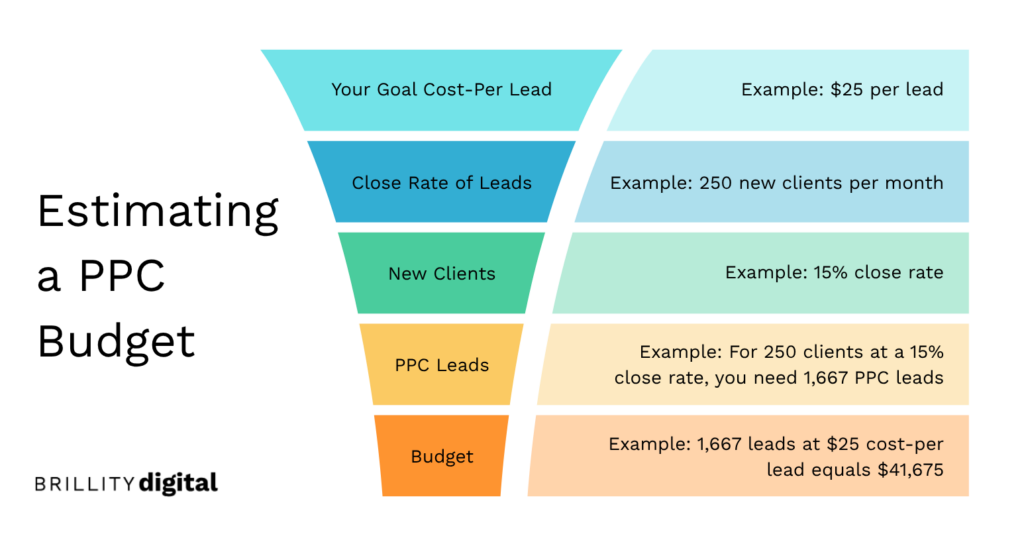
Step 1: Define Your Cost Per Acquisition Goal
Start with:
- How much a customer is worth
- What profit margin exists
- What you can afford to spend to acquire a customer
Step 2: Work Backwards From Revenue Goals
Example:
- Monthly revenue goal: $20,000
- Average sale: $500
- Needed customers: 40
Then determine how many clicks and leads are required.
Step 3: Allocate Budget for Testing
At least 20 to 30 percent of your budget should be reserved for:
- A/B testing
- Keyword expansion
- Landing page experimentation
Step 4: Optimize Before Scaling
Scaling too early is one of the most expensive mistakes in PPC.
Our team specializes in building a Google Ads performance roadmap tailored to your unique goals.
Common Mistakes Businesses Make with Google Ads Budgets
- Starting with no conversion tracking
- Using too small a budget to gather meaningful data
- Optimizing too early before gathering meaningful data
- Ignoring landing page performance
- Scaling based on clicks instead of conversions
We see a lot of business owners who have tried to run Google Ads on their own and have inevitably ended up burning a ton of money in the process. “Without technical knowledge and a solid strategy, it’s easy to lose money running Google Ads. That’s where we step in and turn things around for our clients!” says Brewin.
When Should You Increase Your Google Ads Budget?
You should consider scaling when:
- You consistently hit your target cost per acquisition Your campaigns are fully optimized
- Conversion tracking is reliable
- You have exhausted low-cost keyword opportunities
If these conditions are not met, increasing your budget will usually just decrease efficiency.
So, What Should You Actually Spend on Google Ads?
We know it’s not the answer you want to hear, but… It depends.
No fixed number applies universally.
Instead, your Google Ads budget should be:
- Performance-based
- Data-driven
- Flexible during testing
- Scaled only after validation
Most importantly, your budget should be seen as an investment system, not an expense.
If you’re looking for a clear, numbers-based PPC forecast for your business, Brillity Digital can build a customized PPC budget strategy and help you avoid wasted ad spend from day one!
FAQs: Google Ads Budgeting
How much should a small business spend on Google Ads?
Most small businesses start between $1,000 and $5,000 per month, depending on industry and competition.
Is $500 per month enough for Google Ads?
It can work for very limited testing, but it often does not generate enough data for meaningful optimization.
How long does it take to see results from Google Ads?
You will see results almost immediately, but those early results are primarily data, not optimization. Most Google Ads campaigns require 30 to 90 days of refinement before they become truly efficient and consistently profitable.
What is a good return on ad spend (ROAS)?
This depends on your margins, but many businesses aim for at least 3:1 ROAS as a baseline.
Should I increase my budget if campaigns are not performing?
No. You should optimize first. Increasing spend on underperforming campaigns usually increases losses.